Services preparing for campaign or event traffic
A load model built from expected traffic and conversion ratios shows the breaking point before the event runs.
A performance testing service that validates load, endurance, failure, and recovery against realistic usage patterns.
01Overview
Performance Testing turns real usage patterns into a load model and finds where the system stops holding under stress. A traffic peak, a long run, and a dependency going down are each reproduced, and every bottleneck is named with its likely cause and placed in a remediation order, so the choice between adding capacity and changing code rests on measurement.
02Who it fits
A load model built from expected traffic and conversion ratios shows the breaking point before the event runs.
Database, cache, and external dependencies are cut one at a time to see whether the recovery procedure really works.
Segment response times and resource usage are collected together so the cause is narrowed by measurement, not guesswork.
03What we deliver
01
Normal load, breaking load, and long continuous runs are separated because each answers a different question. Load is generated with JMeter, and the tool follows what the target system requires. Beyond the momentary peak, the resource leaks that only surface after days are visible too.
02
Dependency latency, dependency outage, and instance termination are induced on purpose to watch how recovery behaves. Whether the written procedure holds in the real environment is confirmed in advance.
03
The collected metrics are broken down by segment to name the resource that saturates first. Scaling and code work can then be compared with evidence when the budget is decided.
How the service works
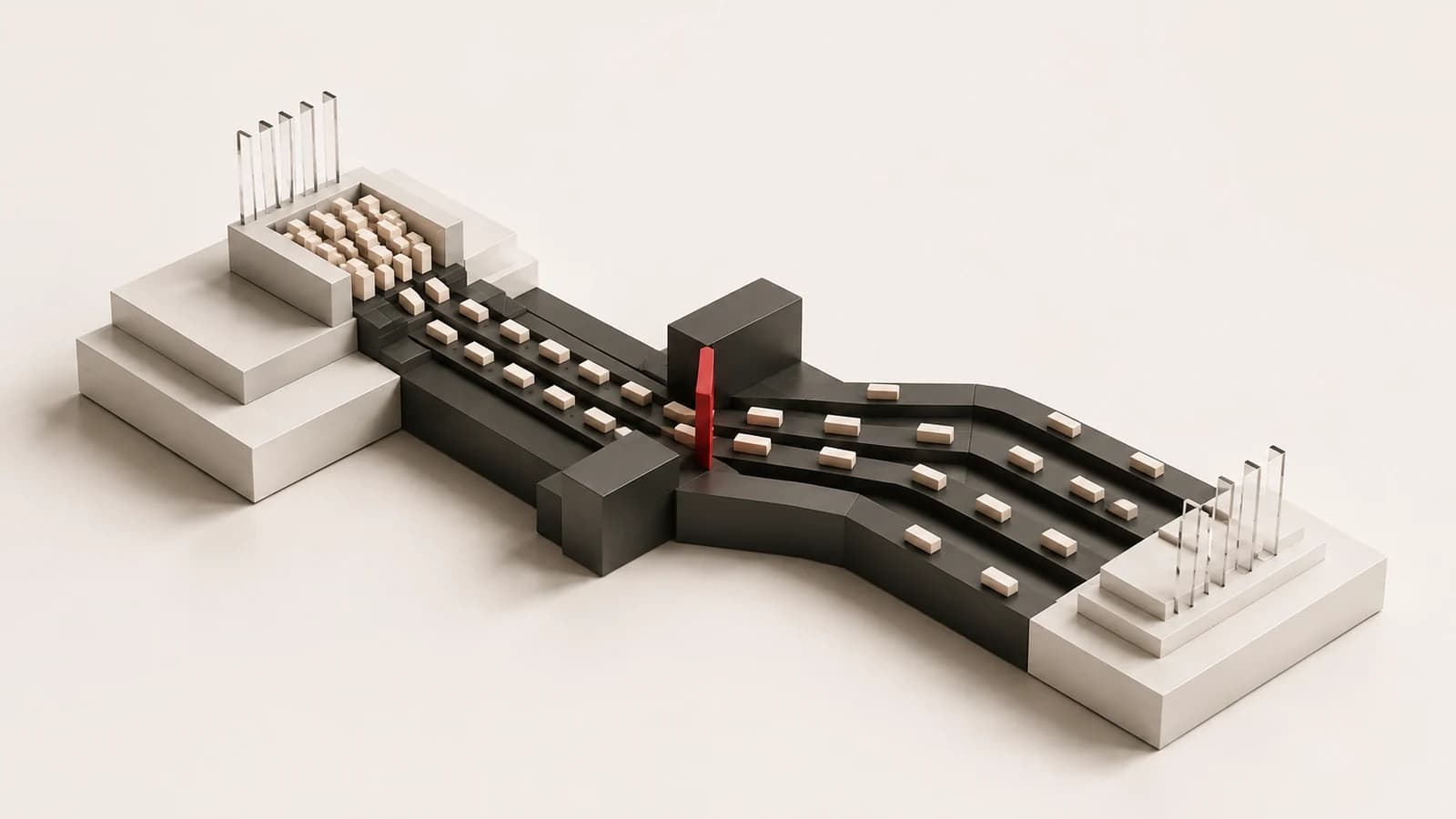
Model the request mix, investigate bottlenecks and retest the effect of each improvement.
04Why this way
Each point lists the deliverable that backs it.
We combine virtual user counts with real request patterns to model production load. Production logs reveal how traffic varies by time of day, how calls are distributed across features, and the share of demanding requests such as search and cart operations. Testing against these patterns gives your team measured limits for capacity and operations planning.
Backed by
Client work · Artist platform
Artist platform, company A — reverse-engineering undocumented code, then verifying all of it
We reverse-engineered the code to recover the requirements, then verified every function against what we recovered.
Learn moreWe turn performance test results into improvement tasks for the next sprint. Each bottleneck comes with a likely cause, a method to verify it, and an estimate of the work involved so priorities are clear. Tasks that need more capacity are separated from those that need code changes, ready for capacity and development planning.
Backed by
Client work · Travel product management
Travel product management, company M — collector load and data consistency
We put load on the collector to find where it gives way, and checked consistency between the database and what the collector returned.
Learn more05How to start
Every stage ends with an agreed scope and a deliverable in your hands.
Step 01
We review product flows and the release calendar together and name the highest-impact failure points within five business days of kickoff.
DeliverableRisk map and validation priorities
Step 02
We link requirements, tests, defects, and the release decision in one traceability sheet and fix the acceptance criteria within two weeks of delivery starts.
DeliverableTest strategy and acceptance criteria
Step 03
We run validation against the agreed criteria and report defects and residual risk weekly in one fixed format.
DeliverableExecution report and defect log
Step 04
We hand test assets and working practices to the internal team and stay available for questions for four weeks afterwards.
DeliverableReusable test assets and a handover guide
06Contract options
07Service levels
5business days
Risk map fixed after kickoff
Weekly
Defect and residual-risk report
4weeks
Questions answered after handover
The distributed storage product needed a measured answer to how far it holds.
What we doReal usage patterns became a load model, normal and breaking ranges were measured separately, and the resource that gives way first was named.
What it leavesWhat remained was a remediation list split between capacity and code, plus capacity guidance operations could use.
The development work we inherited had no documentation, only code.
What we doWe reverse-engineered the code to recover the requirements, then verified every function against what we recovered.
What it leavesWhat the product does, and how, went into documentation, and the point top-up and management feature was built on top of it.
About 1,900 travel products were being maintained by hand, one spreadsheet row at a time.
What we doWe put load on the collector to find where it gives way, and checked consistency between the database and what the collector returned.
What it leavesThe failures we found were in the data, not the features, and product-change handling now runs on its own on top of that.
A no-code test automation tool was heading for its Japanese launch and needed a team to own the localization verification.
What we doWe built and ran some 1,000 Japanese verification cases, hunting the places where wording and behavior diverge.
What it leavesSome 150 localization defects were caught before launch over seven months, and the verification cases remain as an asset for the next version.
An iOS and Android app heading for release needed its security checked from a position independent of the builders.
What we doWe verified the app and its servers together against some 70 security check items, reporting defects with severity and reproduction steps.
What it leavesSome 20 defects were found across the app and servers, and every one was confirmed fixed before release.
So that people no longer chase every product change. We connected collection, storage, display, and ad integration, and checked both whether the data was right and where processing reaches its limit.
09FAQ
Where possible we use a separate environment built to the same specification. If production is unavoidable, we agree the scope, the abort threshold, and who can stop the run first, then start at limited load during the quietest hours.
We divide ownership first: what the in-house team keeps and what we take over is written down, while defect severity criteria and the reporting format stay unified so the release decision rests on one set of evidence.
Yes. We weigh run frequency against maintenance cost and automate the highest-priority journeys first, replacing volatile screen areas with API-level checks or leaving them to manual validation.
You receive the deliverable listed for each stage exactly as it is. Reports come as a document plus the underlying data, and test cases and automation scripts are handed over together with repository access.
Remote delivery is the default, and on-site work is also available. If the test environment is accessible only from your internal network, we first define account access and data-export restrictions, then agree on on-site staffing and duration.
We report defects and remaining risks weekly in a consistent format. Each defect includes severity and reproduction conditions, alongside release readiness, so approvers can decide from the same evidence.
We share the findings from the first stage, then agree scope and schedule on that basis before delivery. A finished request for proposal is not required: the current environment and the outcome you want are enough to start.
2026-08-28 · 31 min read
Convert visitor counts into a request mix, declare pass/fail criteria first, then use the environment fingerprint, a twelve-step load protocol, and a worksheet to record validated sustainable capacity.
2026-09-26 · 17 min read
Review AI-generated test cases first for the evidence behind the requirement, controlled conditions, observable results, and criteria for failure.
2026-09-26 · 19 min read
To turn a production error into a regression test, extract the conditions needed to reproduce it, define expected behavior, and verify that the faulty version violates that expectation while the fixed version satisfies it.
12Related resources
Guides and checklists you can use during review and kickoff.
See all resources2026.06.24
What to weigh when a release date is set and you are deciding whether to bring in an outside review — timing, inputs, how scope is cut, and how long it takes.
Contact
Tell us your current environment and target outcome, and our team will review it and reply.
Direct line
Phone lines are open weekdays 09:00–18:00
ServicePerformance Testing
Collection and use of personal information
You may decline; the inquiry cannot be submitted without consent.
More ways to explore